Artistic Practice Opportunities in CST Evaluations: A Longitudinal Group Deployment of ArtKrit
Honorable Mention
Abstract
Creativity support tools (CSTs) aim to elevate the quality of artists'
creative processes and artifacts. Yet most current CST evaluations overlook
temporal and social aspects of tool use. To address this gap, we present a
longitudinal, group-based CST evaluation through a three-week deployment of
ArtKrit, a computational drawing tool that supports disciplined drawing.
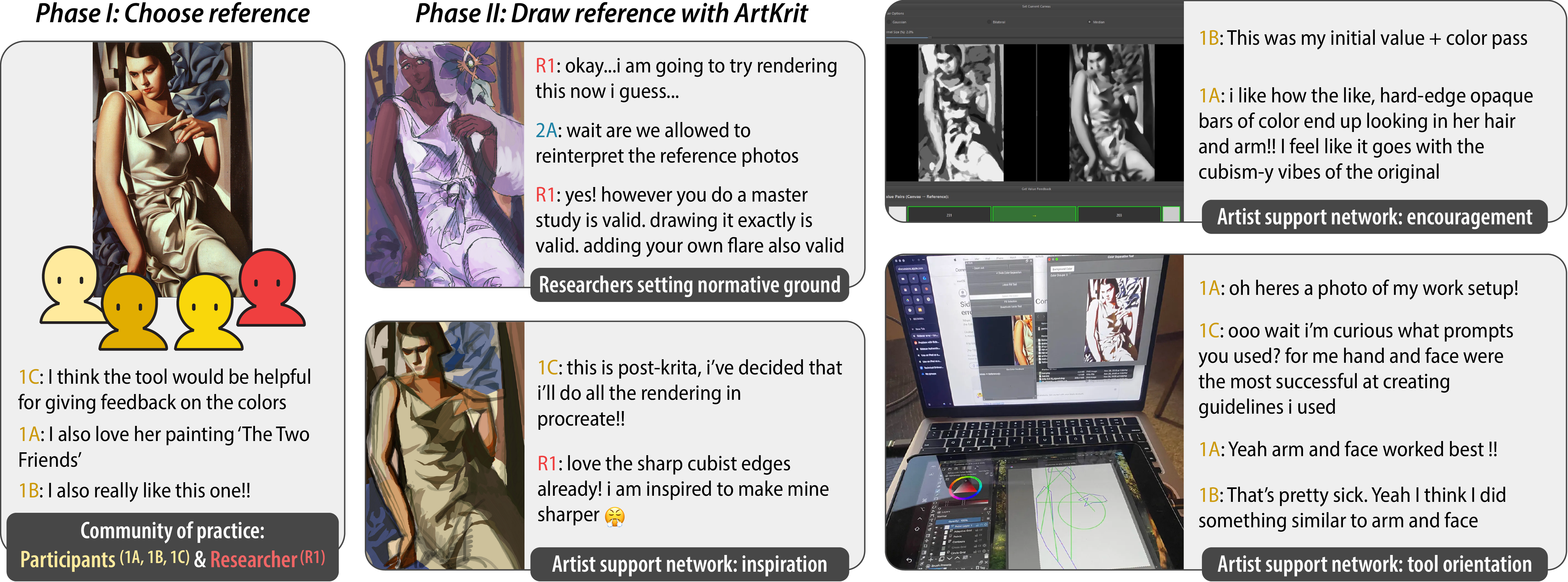
Nine digital artists, organized into three communities of practice, completed
weekly "master studies" alongside a researcher-artist. Our results show users'
evolving relationships with ArtKrit over time - from early experimentation to
selective incorporation or misuse - alongside changes in their ways of artistic
seeing. These changes unfolded within artist support networks that fostered
confidence and creative safety, and validated individual expression. Overall,
our findings suggest that CST evaluations can - and should - be designed as
opportunities for meaningful artistic engagement rather than purely extractive
measurement exercises. We contribute this longitudinal, group-based approach
as one CST evaluation method.